



Home » Holistic Development
At Hari Shree, we are committed to a balanced development of the whole person. Holistic education is educating the whole person beyond just academics. We aim to help children develop physically, emotionally, intellectually, cognitively and spiritually using a comprehensive learning approach. The curriculum is supported by robust co-curricular and extra-curricular programmes, Culture based value education and leadership opportunities.
We provide a safe and supportive environment where students are guided to reflect on themselves and the impact of their actions on the local and global environment and lead children to take ownership for their learning.
Visual/Performing Arts
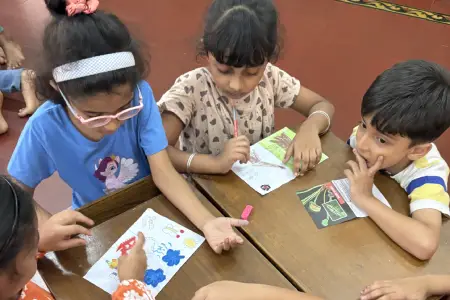
The visual and performing arts programs provide an opportunity to students to explore their creativity in an individualistic and unique way. The programme has a multi-genre, multi-modal and multi-disciplinary approach to it.
At the pre-primary and primary levels, all children learn music, dance, art and theatre. At the middle school and high school levels, visual/performing arts are offered as part of the Creative Expressions (CE) program. Students can choose from among a variety of choices offered. We partner with experts in the respective fields to provide a rich learning experience to children.
Art
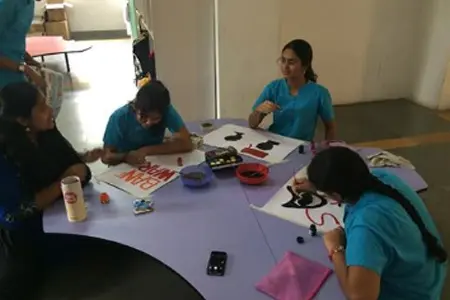
Art and crafts encourage children’s self-expression and creativity. Age-appropriate kinaesthetic activities are incorporated into the curriculum.
At the primary and middle school levels, integrating art with other subjects facilitates in- depth understanding of concepts learnt. Children express their understanding of culture and festivals through appropriate art and craft activities.
At the secondary and senior secondary level, the art curriculum provides a wide knowledge of different artists, art forms, media and techniques.
Music
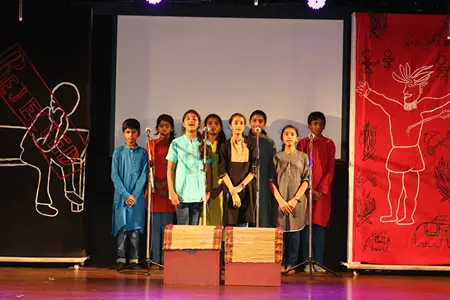
Education through music is a great way to learn. We partner with experts in the field to provide our students with a rich learning experience.
At the Primary level, the musical experience includes approaching other subject disciplines with the creativity of music. There is a focus on specialising in STEM through art integration.
At the middle school and high school levels, students can choose between Western and Indian Classical music. They get an opportunity to learn and showcase various styles and genres.
Dance
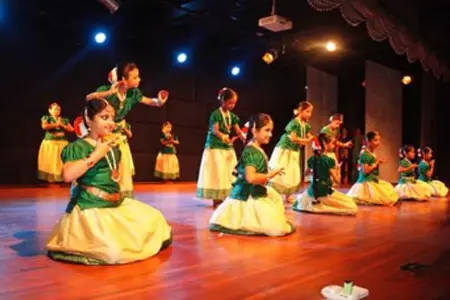
Learning Dance helps children focus, have patience and a clear presence of mind, improve creativity and instills a sense of self-discipline. At the Primary, introducing children to diversity of dance styles through different classical and regional songs facilitates understanding of varied culture and traditions of our country.
At the middle school and high school levels, students get an opportunity to learn various styles and genres under the two main categories of Western & Classical Dance. They are introduced to diverse dance forms each with its own distinct cultural and aesthetic appeal.

Theatre
Theatre aids in enabling students to develop their sensitivity, understand group relationships and dynamics, nurture good enunciation and diction. Theatre classes are designed to offer students the space for equality, equity, empowerment and freedom.
At the Primary, the theatre curriculum focuses on enhancing the intuitive, instinctive, impulsive and imaginative skills of the students. It is designed to empower imagination and articulation so that students are more knowledgeable and expressive about themselves and their surroundings.
At the middle and high school levels, the activities pan across the three main divisions of theatre – acting, designing and direction to help them understand heightened reality, acquire narrative skills and delve deeper into texts and contexts.
Sports
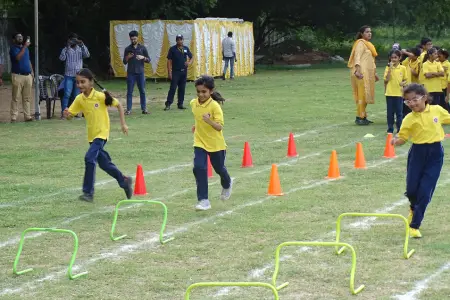
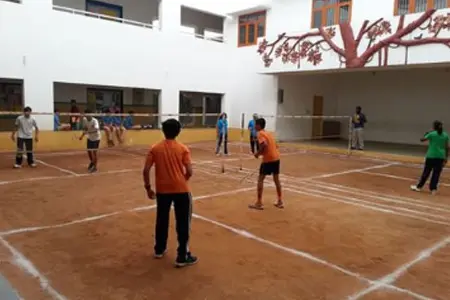
Sports is an important component of the Hari Shree curriculum from pre-primary to high school years, as it promotes an overall development, fitness and agility.
A systematically planned indoor and outdoor playground in the pre-primary campus ensures mastery of perceptual and motor skills needed for reading, writing and math. Sports activities at this level are designed to enhance socio-emotional skills, self discipline and as team building activities that promote working together.
During primary years, sports promote social skills and collaborative work. It improves relationships with peers, helps them to follow simple rules, adhere to boundaries and be introduced to the concept of working in a team.
Middle and high school sports focus on developing accountability, responsibility, resilience, sportsmanship and team spirit. In addition, sports produce endorphins which reduce stress and induce calmness in students.
Career Exploration
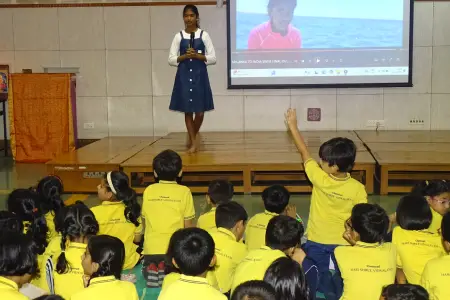
The Skill Development Cell and the Career Guidance Cell work with resource persons and bring in experts to interact with students and guide them. At the middle and high school levels, career guidance is provided to empower students to choose their subjects and to guide them in applying for the right courses for higher education. A network of alumni and parents share their experience in their fields of expertise, through interactions and lectures.
Additional academic counselling and career guidance is provided for students of the secondary and senior secondary, in partnership with external organizations. This career guidance program offers online career assessment and mapping platform, online career guidance webinars, automated career planning tool and tracker, and curated career information and database.
Assemblies
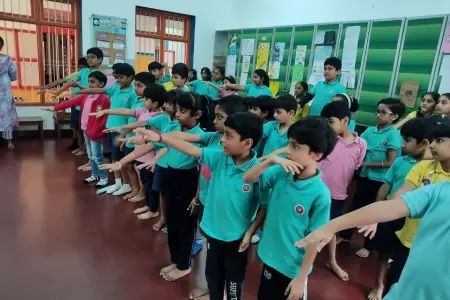
At Chettinad Hari Shree Vidyalayam, assemblies are an integral part of the learning journey, thoughtfully designed to nurture both academic understanding and character development. These purposeful gatherings go beyond routine meetings and serve as vibrant platforms where key learning themes are explored, reflected upon, and brought to life through student voice. Assemblies provide learners with meaningful opportunities to express their ideas, share perspectives, and present their learning to peers, thereby strengthening communication skills, confidence, and public speaking abilities. Students actively participate through talks, skits, debates, presentations, and multimedia showcases, enabling them to articulate thoughts clearly and engage diverse audiences with confidence. Aligned with the Cambridge learner attributes, assemblies also foster teamwork, collaboration, and peer learning. Learners work together in groups to research topics, plan content, and deliver presentations, building essential research, inquiry, and leadership skills. Importantly, assemblies raise awareness of social, environmental, and global issues, encouraging empathy, responsibility, and informed action. Through these inclusive and reflective experiences, assemblies play a vital role in shaping confident communicators, critical thinkers, and compassionate global citizens prepared for the world beyond the classroom.
Skill Enrichment Activities
After school activities are non-scholastic in nature and focus on the interests of students by providing an engaging space for them to enhance their creative and sporting skills, beyond the regular school day. Students are encouraged to engage in activities that they have not been exposed to before.
Wellness Programs
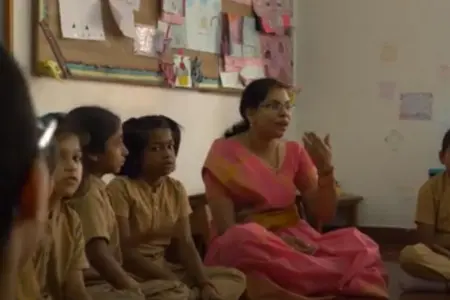
The well-being of a child stems from the feeling of safety and security and extends far beyond just the physical. The mental and emotional wellness of the students is an important part of our routine.